Did you know that roughly one in ten online dating profiles are actually fake? It’s a pretty shocking number. And honestly, that’s really just the tip of the iceberg if you consider the sheer scope of fake profiles plaguing the internet these days. From social media platforms (which, let’s face it, can be a bit of a Wild West) to even professional networking sites like LinkedIn, these deceptive online personas are becoming increasingly sophisticated, making it harder than ever before to tell reality from fiction.
I’m Jake Morgan, and for the past 8 years, I’ve dedicated my career to helping people navigate these murky waters of online identity and protect themselves, and their peace of mind, from online deception. It is a job that keeps me on my feet. In my work, I’ve learned the importance of verifying identities in an age where anyone can assume any face they choose.
My passion ignited when [Share a brief anecdote about a personal experience or a case that sparked your passion. For example: “I witnessed a close friend become the victim of a truly devastating catfishing scam, losing not just a pile of money but also their emotional well-being, becoming withdrawn for a while.” or “In a past role, I investigated a series of fraudulent business deals that were facilitated by fake LinkedIn profiles, and I saw there how online deception has impact far beyond individual victims – it can shake entire industries.”]. In this article, I’m going to distill some actionable strategies that you can use today to really scrutinize online identities, bolster your own online security, and hopefully prevent you from ever becoming a victim of catfishing or other online scams. I believe this content is so vital.
Why It Matters: The Very Real Risks of Interacting with Fake People Online
The internet is amazing, right? Its ability to connect us with others across vast distances is incredible, and it can truly open up new opportunities. The trouble is, that also poses risk. Interacting with fake profiles can have pretty devastating consequences that extend far beyond just a simple waste of your time. It’s very important that you take the risk seriously.
One of the most prominent dangers, of course, is online scams in which, the scammers work to create an emotional impact. Fake profiles are frequently used to lure unsuspecting victims into all sorts of fraudulent schemes, ranging from those ever-present romance scams (which are emotionally brutal) to shady investment frauds that promise huge returns but deliver nothing but financial ruin.
But beyond the purely monetary damage, there’s the very real threat of identity theft, don’t forget. A seemingly harmless exchange of information with a convincingly crafted fake profile can provide criminals with the critical pieces they need to actually steal your identity which is a difficult thing. Then, they can open fraudulent accounts in your name, run up credit card debt, and wreak all kinds of havoc on your credit rating and your personal life.
And we can’t forget about the insidious spread of misinformation. An army of fake accounts carefully crafted to look real can amplify false narratives, deliberately manipulate public opinion, and sow discord and division within society. The emotional toll of interacting with fake profiles, particularly in really toxic cases of catfishing (where the victim truly believes they’ve made a genuine connection), is significant and far reaching. It can lead to feelings of deep betrayal and isolation, and lasting psychological harm. These interactions have a rippling effect and greatly impact the everyday person.
The Foundation: Basic Verification Techniques – Where to Begin
So, before you even think about engaging extensively with someone online, it’s absolutely crucial to lay a foundation with some fundamental verification techniques. These initial methods can offer a surprisingly quick and easy way to get a sense of whether a profile is what it claims to be… or something else entirely.
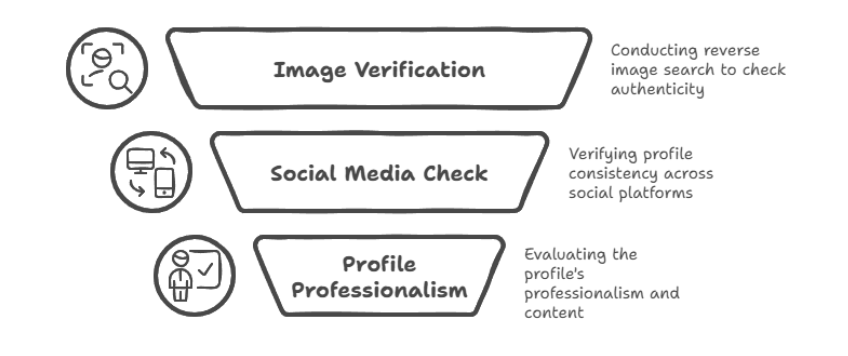
The first, and often most revealing, thing you can do is to conduct a good, old-fashioned reverse image search. It is something simple you can do to get a quick confirmation.
To do this, simply save the profile picture from the person’s account, then upload it to either Google Images (images.google.com) or TinEye (tineye.com). These tools will then scour the vastness of the internet for any other instances of that exact image. If that same picture appears on multiple unrelated profiles or websites-especially if it’s being used as a stock photo or on a completely different company’s about us page-that’s a major red flag.
For example, I remember once investigating a pretty suspicious-looking LinkedIn profile that claimed to be a high-level executive. A reverse image search of the profile picture revealed that the photo was actually a stock image being used on a completely unrelated (and frankly, somewhat shady) company’s website. That ended that potential business relationship right there.
Next, take a careful look at a social media analysis of the person’s profiles, if they have them. Look for inconsistencies in the information they present across different platforms. Does their LinkedIn profile align with their activity, say, on their Facebook page? Do their stated interests actually match their posts and online behaviours? Pay close attention to the age of the account, the number of followers and friends they have (or, critically, don’t have), and the overall quality of their interactions.
Finally, think about profile photo. Are they using a professionally taken headshot that looks like it came from a modeling agency? Or does it appear to be a more candid and natural picture? Do they have one single profile picture at all? Does the image quality even seem consistent with the reported age of the profile itself? These considerations should be pondered.
These basic techniques are the cornerstone of any effective online investigation, so don’t be tempted to skip them.
Deep Dive: Advanced Verification Strategies When You’re Still Unsure
Once you’ve mastered the basics, it’s time to delve into some more sophisticated techniques for verifying a person’s online identity. In my experience, effective online behavior analysis can often reveal inconsistencies that were not obvious at first glance.
Pay close attention to the frequency and the timing of their activity. Are their posts consistent throughout the day and week, or do they follow a too-predictable, almost suspiciously robotic pattern? Do their interactions with other people or pages seem genuine and considered, or do they feel generic and repetitive? For instance, I once flagged a profile as highly suspicious (even though it looked fairly legitimate on the surface) because their posts were always timed perfectly to coincide with peak engagement hours across multiple platforms, suggesting they were using some kind of automation tool, not actually engaging!
Another powerful technique is to cross-reference information against multiple reliable sources. Dig into public records databases, check professional licensing websites (especially if they claim to be in a regulated profession), and see if they’ve been mentioned or quoted in any legitimate news articles. If the person claims to own a property, many counties now have online property records that are easily searchable. These records can potentially confirm if the person actually lives where they say they do.
And finally, never underestimate the power of specialized search tools and dedicated people search engines. These platforms aggregate huge amounts of public data from all over the web, making it far easier to uncover potential discrepancies, such as hidden addresses, associated phone numbers, known aliases, and potentially even past legal records. When using these tools, it’s often effective to search using several different parameters, such as name, location, and approximate age, as that can reveal additional or unexpected results. For instance, I’ve had luck uncovering a previously unknown alias that the person was using.
Red Flags: Common Signs of Fake Profiles – Your Cheat Sheet
Ok, let’s get down to it. Spotting a fake profile is often down to simply recognizing those common telltale signs that something isn’t quite right. Think of this section as your cheat sheet for identifying online deception.
One of the most common, and easily detectable, red flags is inconsistent information, plain and simple. Does the person’s stated age, for example, seem to realistically match their appearance in their photos? Do their self-reported job titles and work history align logically across different platforms? Discrepancies like these are a major warning sign. The more inconsistent a profile, the more time you should spend trying to verify it.
Another thing I always look for are profiles that show a distinct lack of engagement, for example they may rarely post or interact with others. A genuine online presence typically involves some level of interaction, so a lack of engagement is a bad sign.
Finally, trust your gut, and remember the adage that if something seems off, it probably is.
Leveraging People Search Engines Digging Deeper
In today’s digital age, people search engines are totally indispensable tools that can help you verify identities and hopefully uncover hidden information quickly. These platforms pull together public records, social profiles, and all kinds of other online data. They give you a much more comprehensive view of an individual’s online footprint than you would normally be able to achieve.
When using the tools, start with basic search using the person’s full name and the location they’re supposedly based in. Once the results come in analyze them as they come.
A particularly useful feature offered by many people search engines is Something you might want to use is the reverse phone lookup. Used with caution, so, an address lookup can provide useful insights into the person’s current and past residences, as well as names of other individuals who may have lived at the same address. I used this in a past case to determine past illegal behaviour of a suspect by seeing who used to live at his residence.
Staying Safe: Best Practices for Online Interactions – Remember Prevention
Staying safe online is vital, even when identities are verified. One of the biggest factors in avoiding scams is how you interact with online contacts.
Be extremely cautious about sharing details like your full name and number. Be wary of requests for money.
Keep vigilant. By taking an active part in staying safe online, you promote online privacy along with promoting security online.
Conclusion – The Power Is Yours
In today’s day and age, you have to take time to be safe and check people before trusting them. Verify before trusting strangers online.
Remember that you can verify, keep yourself safe and avoid catfishing. Stay active, keep using what you have learned, and verify identities. You have the power to stay safe online, and create a secure online experience!